


Temperature sensor|HTS Code
Temperature sensor belongs to HTS Subheading 9025.19, but the exact 8-digit Harmonized Tariff Schedule code depends on your product specifications. Select the correct code from this list based on your product details.
Hydrometers and similar floating instruments, thermometers, pyrometers, barometers, hygrometers and psychrometers, recording or not, and any combination of these instruments; parts and accessories thereof Thermometers and pyrometers, not combined with other instruments Other than Liquid-filled, for direct reading
Pyrometers
Other than Pyrometers

DeepBeez

Founded in 2025
Tariff Tracker
Temperature sensor
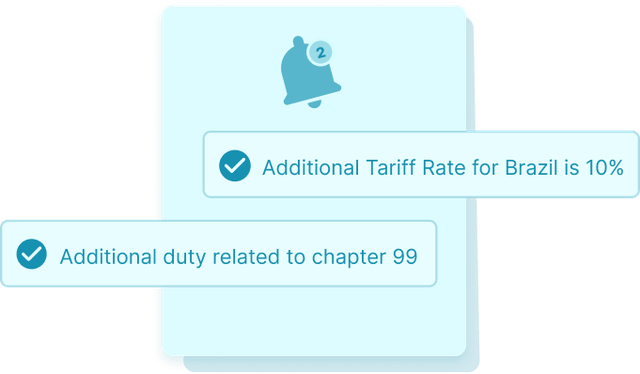
Import Requirements
Temperature sensor

Import Data
Temperature sensor


AI Insight
Plastic Bucket under HS Code 3924-24 shows growing demand in 12 emerging markets with favorable duty rates and limited competition. Our AI has identified key compliance requirements, optimal sourcing regions, and upcoming tariff changes that could impact your margins. See the complete analysis to discover specific opportunities.









Market
Opportunities
Top 5 Partners by Quantity
 United States
 Australia
 India
India Canada


Temperature sensor HS Code description
Temperature sensor harmonized system code
Product Overview: A temperature sensor classified under HTS 9025.19 is a precision thermometer/pyrometer designed primarily to measure temperature as a standalone instrument. Typical sensor types include thermocouples (types K, J, T, E), resistance temperature detectors (RTDs, commonly Pt100/Pt1000 per IEC 60751), thermistors and non-contact infrared pyrometers. Key characteristics: probe/sheath materials (stainless steel 304/316, Inconel), sheath diameters (0.5–12 mm), probe lengths (10 mm–3 m), measurement ranges (−200 °C to +1800 °C depending on sensor type), declared accuracy classes (±0.1 °C to ±2 °C), response times (t63% from 0.1 s to 30 s), and electrical outputs (mV, Ω, RTD curves). Processing levels range from raw sensing elements to factory‑calibrated assemblies with housings and signal conditioning. Quality attributes include NIST‑traceable calibration, stability, repeatability, low hysteresis and specified MTBF. Product classifications within 9025.19 are typically broken down by sensing principle (liquid‑in‑glass, bimetallic, thermocouple, RTD, thermistor, infrared pyrometer) and by construction (probe, handheld, panel‑mounted). Commercial applications include industrial process control, HVAC, pharmaceutical and food temperature monitoring, laboratory instruments, petrochemical and semiconductor manufacturing. HTS Code Classification & Trade Specifications: Complete HTS Code Structure: Chapter 90 — “Optical, photographic, cinematographic, measuring, checking, precision, medical or surgical instruments and apparatus”; Heading 9025 — instruments for measuring or checking temperature and similar variables; Subheading 9025.19 — other pyrometers and other thermometers, not combined with other instruments (6‑digit code: 9025.19). Classification rationale: devices that function solely as temperature‑measuring instruments, without integrated non‑measuring control or remote‑transmission systems, are classifiable under 9025.19. If a sensor is incorporated into an automatic regulator or includes integral transmitters, alternative headings (e.g., 9032 or 9031) may apply — consult technical specifications and binding rulings. Trade considerations: individual anti‑static packaging, foam‑protected probe sleeves, desiccant packets, moisture‑barrier inner packs and unit cartons on ISPM‑15‑compliant pallets for sea freight. If containing batteries, comply with UN 38.3 and IATA DGR. Required documentation and quality standards: IEC 60584 (thermocouples), IEC 60751 (RTDs), ISO/IEC 17025 calibration certificates with NIST traceability, IP ratings (IEC 60529), and RoHS/CE declarations for customs and compliance.
Temperature sensor Chapter Note
1.- This Chapter does not cover : (a) Articles of a kind used in machines, appliances or for other technical uses, of vulcanised rubber other than hard rubber (heading 40.16), of leather or of composition leather (heading 42.05) or of textile material (heading 59.11); (b) Supporting belts or other support articles of textile material, whose intended effect on the organ to be supported or held derives solely from their elasticity (for example, maternity belts, thoracic support bandages, abdominal support bandages, supports for joints or muscles) (Section XI); (c) Refractory goods of heading 69.03; ceramic wares for laboratory, chemical or other technical uses, of heading 69.09; (d) Glass mirrors, not optically worked, of heading 70.09, or mirrors of base metal or of precious metal, not being optical elements (heading 83.06 or Chapter 71); (e) Goods of heading 70.07, 70.08, 70.11, 70.14, 70.15 or 70.17; (f) Parts of general use, as defined in Note 2 to Section XV, of base metal (Section XV) or similar goods of plastics (Chapter 39); however, articles specially designed for use exclusively in implants in medical, surgical, dental or veterinary sciences are to be classified in heading 90.21; (g) Pumps incorporating measuring devices, of heading 84.13; weight-operated counting or checking machinery, or separately presented weights for balances (heading 84.23); lifting or handling machinery (headings 84.25 to 84.28); paper or paperboard cutting machines of all kinds (heading 84.41); fittings for adjusting work or tools on machine-tools or water-jet cutting machines, of heading 84.66, including fittings with optical devices for reading the scale (for example, “optical” dividing heads) but not those which are in themselves essentially optical instruments (for example, alignment telescopes); calculating machines (heading 84.70); valves or other appliances of heading 84.81; machines and apparatus (including apparatus for the projection or drawing of circuit patterns on sensitised semiconductor materials) of heading 84.86; (h) Searchlights or spotlights of a kind used for cycles or motor vehicles (heading 85.12); portable electric lamps of heading 85.13; cinematographic sound recording, reproducing or re-recording apparatus (heading 85.19); sound-heads (heading 85.22); television cameras, digital cameras and video camera recorders (heading 85.25); radar apparatus, radio navigational aid apparatus or radio remote control apparatus (heading 85.26); connectors for optical fibres, optical fibre bundles or cables (heading 85.36); numerical control apparatus of heading 85.37; sealed beam lamp units of heading 85.39; optical fibre cables of heading 85.44; (ij) Searchlights or spotlights of heading 94.05; (k) Articles of Chapter 95; (l) Monopods, bipods, tripods and similar articles, of heading 96.20; (m) Capacity measures, which are to be classified according to their constituent material; or (n) Spools, reels or similar supports (which are to be classified according to their constituent material, for example, in heading 39.23 or Section XV).2.- Subject to Note 1 above, parts and accessories for machines, apparatus, instruments or articles of this Chapter are to be classified according to the following rules : (a) Parts and accessories which are goods included in any of the headings of this Chapter or of Chapter 84, 85 or 91 (other than heading 84.87, 85.48 or 90.33) are in all cases to be classified in their respective headings; (b) Other parts and accessories, if suitable for use solely or principally with a particular kind of machine, instrument or apparatus, or with a number of machines, instruments or apparatus of the same heading (including a machine, instrument or apparatus of heading 90.10, 90.13 or 90.31) are to be classified with the machines, instruments or apparatus of that kind; (c) All other parts and accessories are to be classified in heading 90.33. 3.- The provisions of Notes 3 and 4 to Section XVI apply also to this Chapter. 4.- Heading 90.05 does not apply to telescopic sights for fitting to arms, periscopic telescopes for fitting to submarines or tanks, or to telescopes for machines, appliances, instruments or apparatus of this Chapter or Section XVI; such telescopic sights and telescopes are to be classified in heading 90.13. 5.- Measuring or checking optical instruments, appliances or machines which, but for this Note, could be classified both in heading 90.13 and in heading 90.31 are to be classified in heading 90.31. 6.- For the purposes of heading 90.21, the expression “orthopaedic appliances” means appliances for : - Preventing or correcting bodily deformities; or - Supporting or holding parts of the body following an illness, operation or injury. Orthopaedic appliances include footwear and special insoles designed to correct orthopaedic conditions, provided that they are either (1) made to measure or (2) mass-produced, presented singly and not in pairs and designed to fit either foot equally. 7.- Heading 90.32 applies only to : (a) Instruments and apparatus for automatically controlling the flow, level, pressure or other variables of liquids or gases, or for automatically controlling temperature, whether or not their operation depends on an electrical phenomenon which varies according to the factor to be automatically controlled, which are designed to bring this factor to, and maintain it at, a desired value, stabilised against disturbances, by constantly or periodically measuring its actual value; and (b) Automatic regulators of electrical quantities, and instruments or apparatus for automatically controlling non-electrical quantities the operation of which depends on an electrical phenomenon varying according to the factor to be controlled, which are designed to bring this factor to, and maintain it at, a desired value, stabilised against disturbances, by constantly or periodically measuring its actual value.